

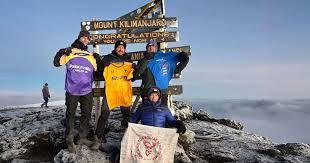
Reaching the summit of Mount Kilimanjaro is not just a physical achievement—it’s an emotional journey filled with struggle, determination, and unforgettable moments. From the freezing midnight start to the golden sunrise at the top of Africa, the summit experience is something every climber remembers for life.
This blog-style guide walks you through what it truly feels like to summit Kilimanjaro.
The Night Before the Summit
Summit night begins long before you start walking.
You arrive at base camp—usually Barafu or Kibo Hut—in the afternoon. The air is thin, the temperature is dropping, and your body is already tired from days of trekking.
Your guide gives a briefing:
- Wake-up time: around 11:00 PM
- Departure: midnight
You try to sleep, but it’s difficult. The cold, the altitude, and the anticipation make real rest almost impossible.
Midnight Wake-Up
You’re woken up in the dark. It’s freezing.
You put on multiple layers:
- Thermal base layers
- Insulated jacket
- Gloves, hat, and headlamp
Outside, you see a line of tiny lights moving slowly up the mountain—other climbers already beginning their ascent.
After a light snack and tea, it’s time to go.
The Slow Climb in Darkness
The climb starts in silence.
It’s not about speed—it’s about rhythm. Step by step.
- Slow pace (“Pole Pole”)
- Deep breathing
- Frequent short breaks
The trail is steep, and the altitude makes every step feel heavier. Even simple movement requires effort.
At this stage, many climbers begin to feel:
- Headaches
- Nausea
- Extreme fatigue
But you keep going.
The Mental Battle
Summit night is more mental than physical.
You question yourself:
- Why am I doing this?
- Can I make it?
Your world shrinks to just:
- Your feet
- Your breathing
- The small circle of light from your headlamp
This is where determination matters most.
Reaching Stella Point
After several hours of climbing, you reach Stella Point on the crater rim.
This is a major milestone.
The horizon begins to glow. The first light of sunrise appears, and suddenly the struggle feels worth it.
You are above the clouds.
Final Push to Uhuru Peak
From Stella Point, it’s about 45 minutes to Uhuru Peak, the highest point in Africa at 5,895 meters.
This final stretch is slow and exhausting, but the excitement pushes you forward.
Then you see it—the summit sign.
The Summit Moment
Standing at Uhuru Peak on Mount Kilimanjaro is surreal.
- Glaciers surround you
- The sky stretches endlessly
- The clouds lie far below
You feel:
- Pride
- Relief
- Emotion
Some climbers laugh. Others cry. Many just stand in silence, taking it all in.
You made it.
The Descent
After photos and celebration, it’s time to go down.
Surprisingly, descending is also challenging:
- Legs are tired
- The sun is now strong
- You’ve had little sleep
You return to camp, rest briefly, then continue descending further.
What Makes the Summit Experience Special?
It’s not just the view—it’s everything that leads to it:
- Days of effort and teamwork
- Overcoming altitude and fatigue
- The shared journey with guides and fellow climbers
The summit is the reward for all of it.
Tips for Summit Night
- Go slowly—pace is everything
- Stay warm with proper layers
- Drink water even if you don’t feel like it
- Listen to your guide
- Keep a positive mindset
Final Thoughts
The summit experience on Mount Kilimanjaro is one of the most powerful adventures you can have. It challenges your body, tests your mind, and rewards you with a moment you will never forget.
It’s not easy—but that’s exactly what makes it so meaningful.

